Search This Blog

Showing posts with label Green Living. Show all posts

Thursday, January 3, 2019

January 14 Forum on Parks Millage


There will be a meeting to discuss the millage (tax to be voted on in May)


MONDAY January 14th

6:30 PM - 8PM

St. Mary's Dominican High School

7701 Walmsley Ave

Secured parking and entry is from Burdeteel Street at the back of the school


Please see the article in Uptown Messenger for additional details


"Voters in May will decide on milestone changes to how the city funds and operates its public recreational spaces. To give New Orleanians a clearer understanding of how these cherished city services could be overhauled, the Carrollton Area Network is holding a public forum Jan. 14.
Presenters from the Audubon Institute, the New Orleans Recreation Development
Commission, Parks and Parkways and New Orleans City Park will discuss at a forum moderated by Keith Twitchell of the Committee for Better New Orleans.


The ballot proposal would give City Park its first dedicated millage while reducing the millage for Audubon Park by nearly half. Parks and Parkways and the New Orleans Recreation Development Commission would see an increase in their funding. Property owners continue paying the same amount under the 20-year plan, city officials say.
The new parks overhaul also calls for unified oversight for the city’s recreational entities under a cooperative agreement approved by City Council on Dec. 20.


This agreement allows more resource-sharing among the four agencies. They could more easily leverage their buying power in negotiating contracts, share large equipment for maintenance and beautification projects, and exchange information and strategies on storm-water control, fundraising, social media communication and other activities.
Programming among City Park, Audubon and NORDC would be shared to increase access to recreational activities. The agreement also calls for increased safety and environmental initiatives.


The four agencies’ top executives are to meet quarterly under the plan and to hold public meetings twice a year.


The May ballot proposal would adjust the millage rates from 2021 to 2040. If the millage adjustment passes, the current 6.31 mills, expected to bring in about $22 million, would be distributed as follows:
• Audubon would receive 1.95 mills ($6.59 million) instead of the current 3.31 mills ($10.92 million);
• NORDC’s adjusted millage would be increased to 1.95 mills ($6.59 million) from 1.5 mills ($4.95 million);
• Parks and Parkways’ millage would be increased to 1.8 mills (or $6.08 million);
• City Park would receive .61 mill (nearly $2.06 million)."



Thursday, January 4, 2018

Entergy has Rooftop Solar Meeting!

PLEASE SHARE THIS WITH YOUR NEIGHBORHOOD MEMBERS AND COMMUNITY LEADERS 
(LOCATION CHANGED TO SUNO’S LAKE CAMPUS – COLLEGE OF BUSINESS AND PUBLIC ADMINISTRATION, ROOM 100) - -
NOTICE IS HEREBY GIVEN THAT ENTERGY NEW ORLEANS, LLC. (“ENO”) WILL HOST A PUBLIC MEETING TO PROVIDE INFORMATION AND ANSWER QUESTIONS SURROUNDING ENO’S APPLICATION FOR APPROVAL TO CONSTRUCT DISTRIBUTED GENERATION (“DG”) SCALE SOLAR PHOTOVOLTAIC (“PV”) SYSTEMS, FILED WITH THE COUNCIL FOR THE CITY OF NEW ORLEANS ON OCTOBER 6, 2017. ENO’S APPLICATION PROPOSES TO CONSTRUCT MULTIPLE DG-SCALE SOLAR PV SYSTEMS, WITH A TOTAL COMBINED CAPACITY OF APPROXIMATELY 5 MWAC, LOCATED IN THE CITY OF NEW ORLEANS. THE PROJECT IS THE FIRST OF ITS KIND FOR ENO AND REPRESENTS A MAJOR MILESTONE IN ENO’S COMMITMENT TO INVEST IN RENEWABLE GENERATION RESOURCES.  IN THIS PUBLIC MEETING, ENO WILL ADDRESS VARIOUS TOPICS RELATED TO THE PROPOSED PROJECT, INCLUDING:
HOW DO SOLAR PV SYSTEMS WORK?
                                      What is a DG-Scale System?                                             
IS THERE A MINIMUM SIZE FOR EACH SYSTEM?
WHERE WILL THE SYSTEMS BE LOCATED IN THE CITY?
WHAT KIND OF BENEFITS WILL THE PROJECT BRING TO NEW ORLEANS?
WILL LOCAL LABOR BE USED TO CONSTRUCT THE PROJECT?
WHEN WILL CONSTRUCTION BEGIN?
WHY IS THE PROJECT SUITABLE FOR NEW ORLEANS’ NEEDS?
HOW CAN CITIZENS LEARN MORE ABOUT THE PROJECT?
HOW CAN CITIZENS EXPRESS SUPPORT FOR THE PROJECT?
 
MEMBERS OF THE PUBLIC ARE INVITED TO ATTEND THE MEETING AND TO SUBMIT QUESTIONS IN ADVANCE
VIA ENO’S WEBSITE. 
www.entergyneworleans.com/powertogrow/rooftopsolar.
THE PUBLIC MEETING WILL BE HELD TUESDAY, JANUARY 9, 2018,
AT THE FOLLOWING LOCATION FROM 5:30 P.M. – 7:30 P.M.:
SOUTHERN UNIVERSITY OF NEW ORLEANS – LAKE CAMPUS 
COLLEGE OF BUSINESS AND PUBLIC ADMINISTRATION
6801 PRESS DRIVE, ROOM 100
NEW ORLEANS, LOUISIANA 70126
 
 
This e-mail may contain personal information, and must be protected against unauthorized access or disclosure in accordance with the Protection of Information Policy
Picture3

Saturday, August 12, 2017

New Orleans and Drainage

It's a SYSTEM. It doesn't work when too many parts are broken.
And lots of parts are broken, above and beyond the pumps and the turbines.
Catch Basins not kept clean by the people who live on the street.
Catch Basins not mucked out by the city.
The city paving such that very little space is left for water to get into the Catch Basins.
People consistently breaking the laws like:
Littering which blocks up the Catch Basins,
Blowing leaf litter and grass cuttings into the storm drains,
Parking on the greenspace between the sidewalk and the street which grinds off the grass and lets dirt flow into the Catch Basins and reduces the ability of the compacted ground to absorb, and, if parked on, can damage the catch basins,
Paving front yards,
Over paving period.
And things not done that do help absorb water like:
Planting trees,
Holding water on your property whether it's taking advantage of deep Arts and Crafts eaves to live without gutters so the water doesn't run straight to the street or rain barrels and rain gardens,
Using new technology to create more permeable surfaces.
When we forget it's a SYSTEM and we allow incompetence and malfeasance we get what we got.

Friday, August 11, 2017

Catch Basins and Leaf Blowers

Is it legal to use a leaf blower to blow leaf litter and grass cuttings into the street?
NO!  
and if you don't believe me, below is the ordinance prohibiting this practice. 

Please remind your friends and neighbors who use yard maintenance contractors so that this practice does not occur.  And if you do it yourself, you should probably cut that out.
Sec. 66-287. - Sweeping from premises and sidewalks to be taken up.
The owner, his agent or occupant, of all premises shall be responsible to take up or cause to be taken up all aggregate sweeping of garbage, trash, litter, grass cuttings, leaves and all other waste materials from the premises, sidewalks and abutting property including the space between the property line and the curbline in front, extending 1½ feet from the curbline into the street or roadway and in the rear and alongside thereof of such premises owned or occupied so that such sweepings shall not under any circumstances reach the drains, gutters, streets or roadways. The owner, his agent, or occupant shall be responsible to have all sweepings placed into containers sufficient to prevent such sweeping from being scattered by the wind and placed out on the days designated for collection.
(Code 1956, § 28-19)

Sec. 66-287.1. - Use of leaf blowers to transfer or direct debris to public drains prohibited.
(1)
Definitions.
Leaf blower. A mechanical, battery-operated or gasoline-powered device which projects pressurized air forward to cause movement of leaves, grass or other debris commonly associated with grass cutting, lawn care, gardening or yard maintenance activities.
Public drain. Includes catch basins or gutters located parallel to public rights-of-way, open segments of city subsurface drainage conduits, flood control and water path canals or drains located on public property and incorporated into the public infrastructure for wastewater management or scipening.
(2)
Use of leaf blower to impede or restrict drainage or water flow prohibited. Use of leaf blower for private or commercial use in any manner which causes or results in the transfer, movement or directing of grass, leaves, yard debris, debris derived from yard maintenance, lawn care or any activities whereby debris is accumulated and projected to public drains or results in impeded water flow of public drains or restricts the public designated purpose of such drains is prohibited by law. Violators shall be subject to citation or administrative adjudication by duly authorized code enforcement officers or duly authorized law enforcement officers.

(M.C.S, Ord. No. 21912, § 1, 4-7-05)


Sunday, August 6, 2017

Healthy Catch Basins and 311

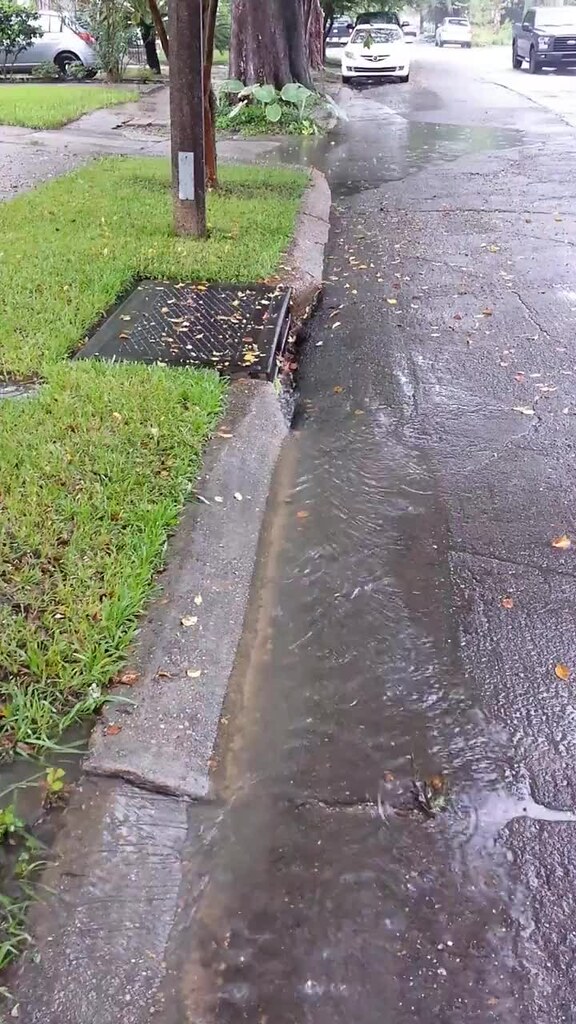
This is what a healthy catch basin looks like:
Greenspace not parked on,
Trees,
Clear of debris,
And most importantly: FLOWING.

If you see a catch basin surrounded by water today it is either because:
it is the lowest spot in the area (note the area in the background),
it is blocked and you can clear the blockage (and why not littering is important),
Or the city needs to MUCK out the catch basin.

Today is the day to do this assessment in your neighborhood.
If you see a problem be specific with the street address and call it in to 311
or better yet send a photo and an email to 311@nola.gov.
You don't see the problem when it's dry.


  20544755_215854912274394_829099559106904064_n

Friday, August 8, 2014

Painted Utility Box on Carrollton @ Apricot (Walmsley)

Perhaps you noticed the newly painted utility box on Carrollton?

CVUNOLA.org has program that works with neighborhood organizations to paint utility boxes.
 
Yep, that's a Raccoon in the tree.

Egrets and Herons are frequent visitors to NorthWest Carrollton

as are opossums


That would be Archie, the neighborhood peacock.


Sunday, November 24, 2013

Private Property Rights and your backyard

·         Clearing of trees: As the law stands now, one only needs approval of the City before trees are removed from public space (such as the right-of-way adjacent to the street). Removal of trees on private property is not regulated.

·         Paving: As the zoning ordinance is written now, the only limitation on paving is within the required front-yard. Beyond the 40% limitation in the required front-yard area one is free to pave their entire lot.

o   The draft zoning ordinance (CZO) speaks to more extensive paving, but that ordinance is probably about 6-months from adoption.

o   Additionally, the Sewerage and Water Board is proposing to create a mechanism to have people pay for the impact of their paving on the City’s stormwater system. The hope is that this will create an incentive to have more permeable surfaces in our urban environment.

o   Even though there is no limitation on paving, one is not allowed to shed water to a neighbor’s property. The property owner will have to accommodate their own water either through grading the lot to channel water to the street or installing drainage.

Friday, November 8, 2013

Tree Giveaway

Native Trees Giveaway 

Thanks to grants from Apache and ACTrees, Parkway Partners is giving away 400 Native Trees.  Limit 2 per household to Orleans Parish residents.

Where:
Parkway Partners
1137 Baronne St.
NOLA 70113

(at corner of Clio in Central City)


When:

This Saturday, November 9

Gates are open from 9am-noon


Why:

Parkway Partners' numerous programs supporting urban trees are all part of an effort to re-forest New Orleans.  We are the most de-forested city in the U.S.! All proceeds from 2nd Saturdays go directly back into the 2nd Saturday Educational Program.

Tuesday, October 29, 2013

More Trees for New Orleans

On Nov. 14, 2013 from 7-10pm, MotherShip Foundation will host a 
fundraiser and auction benefitting the Restore the Bayou Canopy 
Campaign. The event will take place at Pearl Wine Co. in the American 
Can Building and will feature entertainment by local artists. In 
addition to the musical entertainment, Marlin Miller—the artist who 
carved the public art sculpture out of the dead oak tree on the corner 
of Orleans Ave and Jeff Davis Pkwy—will also be at the event to share 
his story and auction off a few or his one-of-a-kind sculptures. 
Tickets, which include wine and food, are $50 for individuals or $75 
per couple—with one hundred percent of the proceeds benefiting the 
Restore the Bayou Canopy Campaign.

On Saturday, November 16th, all are invited to witness and celebrate 
the major tree planting on Bayou St. John.

http://fsjna.org/2013/10/trees-on-the-bayou/

Friday, October 25, 2013

Wildlife Habitat in NorthWest Carrollton

Send email to nwcarrollton@mindspring.com if you are interested in turning your yard into a Certified Wildlife Habitat.  We already have one Certified Wildlife Habitat in the neighborhood and would love to add more.


The information below is taken directly from National Wildlife Federations Website

Autumn brings dramatic changes in the bird life of any North American backyard. As many of the feathered residents that visit your yard during summer go south, migrants from regions to the north will pass through. Some will make brief stopovers while others will spend the winter.
You can make the most of this seasonal avian passage by making some adjustments to your property that will attract greater numbers of different birds in the fall—and help them thrive. Consider the following ideas:
 1. Provide running water:
 The sound of running water in a birdbath or pond will be heard by migrating birds from some distance, and will draw them to the bath for a drink, and possibly a quick dip. Most migrants that visit birdbaths with running water eat insects. These include warblers, vireos, flycatchers, thrushes and thrashers. In addition, the juveniles of summer resident birds are likely to spend more time at the pool before moving to more southern climes.
Tip: Running water can be created in a single pool birdbath by installing an electric mister or bubbler, available from bird supply stores. A small pump will move water in a multiple-tiered birdbath, causing the water to make a splashing noise as it recirculates from top to bottom.
2. Leave sugar water feeders out:
Don’t take down sugar water feeders as soon as local hummingbirds and orioles start leaving in the fall. There are huge numbers of hummingbirds and orioles that have spent the summer farther north; as they migrate through your area, they will recharge themselves at the feeders. And juvenile hummingbirds, the last to abandon nesting grounds, feed on sugar water long after their parents have gone south.
3. Clean out birdhouses:
Early fall is a good time to clean out and make necessary repairs to birdhouses in preparation for hosting species that roost during fall and winter. The old nests usually attract insects and parasites and should be removed before winter residents move in. In many areas, bluebirds, chickadees, nuthatches and winter wrens may take up nightly residence in birdhouses to keep warm and safe.
4. Create brush piles:
Save your fall clippings of branches and twigs and pile them in a corner of the yard (where they will be less intrusive) to create cover for birds. Most birds that prefer habitat on the ground—such as dark-eyed juncos, tree sparrows and white-throated sparrows—will use brush piles for roosting at night and for protection from predators.
Tip: Fallen evergreen trees, placed along the border of the yard, create more cover that will last throughout the winter.

 5. Plant evergreens:
There is no better natural cover for birds in fall and winter than evergreens. Planted near feeders and birdbaths, they will attract migrants and provide cover (and thus increase the safety factor) for many birds after deciduous trees lose their leaves.
6. Increase the number of feeders:
Autumn is a good time to double the number and kinds of feeders you put out for the birds. Starting with the first cool fall days, the consumption of bird food will increase and continue to increase as the average daily temperatures drop.
Tip: To attract the greatest number and variety of birds, provide a variety of seed and suet feeders. Northern cardinals, for example, prefer tray feeders, where they can perch on a ledge, while chickadees are more adept at landing on small perches or clinging to wire netting that surrounds feeders. Other birds, including several species of sparrow, feed on or near the ground, while woodpeckers are drawn to suet hanging from tree trunks.
7. Move the action closer:
One of the main reasons for feeding birds is so that you can enjoy watching their behavior in a natural environment. If you move your bird feeders and birdbaths closer to the house, you can get close to the creatures without disturbing them.
 Tip: If there is not enough natural cover just outside the windows, plant some or place potted evergreens around the feeders and baths. The birds will adapt to being close to the house quickly.
8. Provide foods for insect eaters:
Many birds that frequent backyards will not eat seeds, but they will eat insects and fruits. Cedar waxwings, American robins, northern mockingbirds, some woodpeckers, and migrating thrushes, thrashers and tanagers will feed readily on chunks of apples, berries and jellies from containers. Bluebirds, robins, mockingbirds and some woodpeckers will eat live mealworms (available at pet supply stores) served in a tray feeder.
9. Bring bird sounds indoors:
With the arrival of cooler weather, people tend to close their doors and windows, blocking out the pleasant sounds of birds singing, scolding and chattering. If you like those sounds, consider installing a wireless baby monitoring device outside, and send the sounds of nature inside to a well-placed receiver.
10. Protect birds against collisions:
More birds collide with windows during fall than any other season of the year. Often migrating birds that are not familiar with the terrain will see the reflections of a woodland in a windowpane and fly right into it. If the reflection can be removed or muted with soap, netting, screening or by hanging streamers on the outside, the birds will veer away from it.
Tip: Whatever technique you use, do it on the outside of the pane. Pulling drapes inside will enhance the reflection on the outside. Pasting silhouettes of birds of prey, such as hawks and owls, may also help deter flying birds.

Adapted from "Avian-Attractions " by George Harrison, National Wildlife , October/November 2003.

Sunday, July 7, 2013

Trees Fight Crime

Just one more reason why we plant trees.
IMAG0389-1
Whole Living September 2012 issue

Tuesday, July 2, 2013

Dark Skies - Understanding Lighting - Preservation in Print

See full article online at PRCNO Preservation in Print

Clips and quotes are below

...100 Watt metal halide lamps produce too much glare and are over-scaled for the poorly designed reflector....

Light emitting diodes (LEDs) are the answer.

Basically building owners have been trying to light the street for safety but instead have been creating glare.

Friday, June 14, 2013

How to build community

Pick up litter....

or old tires....

We pick up old tires in the neighborhood. The city's contract for garbage handling indicates the 2 tires can be picked up each week as long as they are next to a city supplied garbage can on garbage day.

We also report abandoned cars to NOPD.

Wednesday, June 12, 2013

Louisiana Irises in the Costco landscaping

When you see Louisiana Irises in the Costco landscaping... this is the back story.
I guess this is what they mean when they say the power of social networking.

These Costco folks are pretty amazing.
Can't wait for the store to open!

From: NorthWest Carrollton
Sent: Jun 2, 2013 11:58 AM
To: Susan Guidry - Council District A, Stacy Head, Ann McDonald - Parkway & Parks
Subject: Irises at Costco and Washington & Carrollton streetscape

Dear Council Members and Parks & Parkways;

This weekend there was an interesting post and conversation on Facebook regarding the streetscape at Washington & Carrollton regarding Louisiana Irises.

Here is the link that started the conversation:
http://southeasternarchitecture.blogspot.com/2012/10/lost-louisiana.html

and here is the quote that created the idea to have Costco (and Parks & Parkways) include native Louisiana Irises in the landscaping. 

" 'During the past twenty-five years, I have witnessed the most frightful destruction amongst the irises within the city limits of New Orleans and adjoining parishes, even worse than that of the Frenchmen Street location. At the junction of Washington and Carrollton Avenues, there was a patch of several acres, which when in bloom appeared to be a solid mass of iris; today not one remains. At the site of Newcomb College there was a fine stand of Iris fulva. This has disappeared entirely.' "
As a result of this conversation, we are asking if it would it be possible to request that Costco ( and Parks & Parkways) use Louisiana Irises in their landscaping. These are local, native plants and when it rains their blooms explode. It could be a nice nod to the location and honor the site's history. Additionally large clumps of irises don't require as much maintenance and could be more cost effective long term.

Respectfully & hopefully,
Jenel Hazlett
Elaine Leyda
(with thanks for the e-conversation that included Cathe Mizell-Nelson, Kiki Reinecke, Timmie Reinecke Cass Cairns, Barb Masinton)


The email above got us a contact at Costco and we wrote a second email

Mr. Fuller;

We are looking forward to having Costco so centrally located and close to our neighborhoods. This Saturday our City Council Representative Susan Guidry participated in the ribbon cutting for the streetscape at Washington and Carrollton. Today there was an e-conversation regarding the lost of Louisiana Irises in the New Orleans streetscape.  Given the synchronicity, we are writing you with the hope that Costco might be interested in an idea that bubbled up among neighborhood leaders this morning on Facebook to have Costco use Louisiana Irises in the landscaping at the new New Orleans location.   As the article in the link below indicates  "At the junction of Washington and Carrollton Avenues, there was a patch of several acres, which when in bloom appeared to be a solid mass of iris; today not one remains."  We are hoping that you will bring this idea forward to the team responsible for the New Orleans site.  We feel it would be a nice nod to our history and could even long term be cost effective landscaping as once established irises require very little maintenance. We also contacted our city council representatives to see if we can't encourage the city to use irises in their portion of the streetscape.

Sincerely;
Jenel Hazlett
Elaine Leyda
residents of the Carrollton neighborhood in New Orleans
http://southeasternarchitecture.blogspot.com/2012/10/lost-louisiana.html
http://en.wikipedia.org/wiki/Louisiana_Irises


And within 6 days we had this answer from Costco

Jenel and Elaine,

Thank you very much for your recent e-mail concerning the Louisiana Iris and our new Costco.
 
We have identified a few areas on our site where we can substitute scheduled plant material for Louisiana Iris.
These areas would be at our site corners and entrances at Dixon and Carrollton, Dixon and Dublin and at the entries along Palmetto.
Please see the attached PDF with the areas highlighted in pink. 
I hope that this effort meets the spirit of your request, and regret that we can not provide additional coverage due to the fact that the majority of the plant material has already been ordered or purchased.
 
We are looking forward to our first Louisiana location joining the neighborhood.
 
Sincerely,
Todd Thull
Vice President
Costco Construction
Costco Irises in pink boxes1 Costco Irises in pink boxes1

Friday, May 10, 2013

Thursday, May 2, 2013

Ron Finley.... has the answers


"Gardening is the most therapeutic & defiant act you can do... especially in the inner city."

Sunday, April 28, 2013

outreach requests for Jean Lafitte NHP&P BioBlitz & summer interns -- volunteers, housing ...

Dear Colleague,
 
My Jean Lafitte NHP&P colleagues and I seek your assistance with BioBlitz event volunteer recruitment and with helping our summer interns to find inexpensive local housing.  Please forward/distribute this message to your students and colleagues.
 
+ We need volunteers to help us carry out the BioBlitz at the Barataria Preserve.  Volunteer roles range from assisting with educational activities to processing biodiversity samples to assisting experts with biodiversity inventories to registering participants and event maintenance work.  To learn more about specific volunteer opportunities, explore the volunteer registration website.  You can make a difference!
 
+ We seek housing for interns who will work with Jean Lafitte NHP&P's natural resource management group this summer.  If you know of inexpensive housing in the New Orleans metropolitan area, or if you wish to rent a room in your home or sublet your place, please contact me and/or Dusty Pate.  We seek to direct interns to housing beginning between May 4th (!) and early June and extending for up to 16 and 10 weeks, respectively.
 
+ We still welcome BioBlitz participation by natural history experts and scientists.  It's not too late to register (ignore the opposing statement on the NGS website).  We seek leaders and co-leaders for public inventories, experts who prefer to identify taxa from field-collected samples, and experts who wish to assist with planned educational activities.  See the scientist information page or go directly to the expert registration site.
 
+ Finally, we welcome your participation in BioBlitz biodiversity inventory and festival activities on Friday 17 May and Saturday 18 May!  Join us with your family, friends and neighbors at the Barataria Preserve for an exciting two days of biodiversity discovery and appreciation.  Learn more about the event at our website and/or register now (go to bottom of web page) to participate in a specific inventory.
 
Thanks for distributing this to your students and colleagues.
 
with best wishes,
Julie
--
Julie L. Whitbeck, Ph.D.
Ecologist
Jean Lafitte National Historical Park and Preserve
419 Decatur St.

Saturday, April 20, 2013

Lafitte’s Barataria Museum & Wetland Trace

TOWN OF JEAN LAFITTE UNVEILS

LAFITTE’S BARATARIA MUSEUM & WETLAND TRACE

About the Museum:
The 6,000-square-foot, $350,000 wildlife and fisheries museum tells the 200-year-old story of the Town of Jean Lafitte, a historic fishing village 20 miles southwest of New Orleans. Featuring a multi-media theatre presentation, an animated museum exhibition and a nature study trail, the museum leads visitors on a journey through the life of pirate Jean Lafitte, the stories and folk traditions of wetland dwellers and the realities of coastal erosion and natural and man-made disasters.
State-of-the-art animatronic figures include a talking alligator as well as a surprise guest who is in search of “the golden thimble.” At the end of the exhibit, visitors emerge to a mile-and-half cypress swamp trail leading to a bayou, rookery and marsh area, filled with alligators, snakes, spiders and exotic birds.
Exhibits displayed in the museum come from the former Louisiana Marine Fisheries Museum provided by the Louisiana Secretary of State, the Louisiana Wildlife & Fisheries Collection from the original Louisiana State Museum in the French Quarter and the Town of Jean Lafitte’s special historical collection.

Location:
Multi-Purpose Center
4917 City Park Dr.,
Lafitte, LA
504-689-2299

799 Jean Lafitte Blvd.
Lafitte, LA
504-689-2299 begin_of_the_skype_highlighting 
Mon.- Fri. 9pm – 3pm

Tuesday, April 16, 2013

Economic Synergies across Southeast Louisiana

Dear friends and colleagues,
 
Southeast Louisiana has received high marks for its economic performance during the Great Recession. But projected job growth through 2020 is expected to lag Houston, Austin-San Antonio, Raleigh, and Atlanta—which are benefiting from earlier efforts to diversify their economy.

At the same time, relative sea level rise is rapidly increasing flood risk.
 
By working together to harness their economic synergies, New Orleans, Baton Rouge, and Houma-Thibodaux can diversify into emerging industries such as clean tech and digital media, while at the same time fortifying existing specializations in energy, advanced manufacturing, and water management.
 
In our new report, we highlight:
  • Southeast Louisiana's significant expertise in engineering and scientific consulting, heavy construction, and water transportation.
  • The synergistic role of wetland restoration activities toward Southeast Louisiana’s economic transformation.
  • The importance of working collaboratively across Baton Rouge, New Orleans, and Houma-Thibodaux.
Read our report,
to learn more about the challenges and opportunities facing Southeast Louisiana at:
 
 
Bringing you the data you need to make informed decisions,
 
The GNOCDC team
 
Charlotte Cunliffe, Elaine Ortiz, Ben Horwitz, Allison Plyer, and Susan Sellers
 
@@@
 
The Greater New Orleans Community Data Center is a product of Nonprofit Knowledge Works and is supported in part by United Way of Southeast Louisiana, Baptist Community Ministries, JPMorgan Chase Foundation, Metropolitan Opportunities Fund at the Greater New Orleans Foundation, RosaMary Foundation, John S. and James L. Knight Foundation, blue moon fund, and data users like you.
Greater New Orleans Community Data Center
1600 Constance | New Orleans, LA 70130
www.gnocdc.org

Thursday, April 11, 2013

Backyard Beekeeping

THIS SATURDAY, April 13th
Backyard Beekeeping
Gates are open from 9am - noon
1137 Baronne Street, New Orleans, LA 70113
o 504 620 2224  
 
Urban beekeeping expert, Russell Harris, speaks at 10am.  Come learn how to start your own colony of bees and keep this indispensible species thriving in New Orleans. 
 
Available at the Greenhouse: Vegetables, herbs, LA SuperPlants and lots of color.  Special sale on trees.
 
Arrive early to get a seat!
 
bees